

Introduction to NADRA CNIC Impoundment Law 2026
The NADRA CNIC impoundment law 2026 introduces a major shift in how identity verification is handled in Pakistan. The amendment allows the National Database and Registration Authority to take temporary action against suspicious or unverified identity cards. This step reflects the government’s focus on strengthening internal security and ensuring that national identity documents are used responsibly.
The CNIC has become an essential tool for accessing services like banking, mobile networks, and government programs. Any misuse can create serious challenges for the country’s economy and security system. By introducing this law, authorities aim to improve oversight and reduce fraudulent activities linked to identity misuse.
- CNIC is a key identity document in Pakistan
- Misuse can affect security and economy
- New law enhances verification authority
- Focus on preventing illegal usage
You Can Also Read: 1500 Prize Bond List 2026 Online Check: Complete Result, Draw Schedule & How to Check
NADRA CNIC Impoundment Law 2026 Approved by Senate Committee
The NADRA CNIC impoundment law 2026 was approved by the Senate Standing Committee on Interior after detailed discussions. Officials explained that the amendment was necessary to update existing laws and address modern security challenges. The committee reviewed the proposal and agreed that stronger legal backing was required for NADRA to perform its duties effectively.
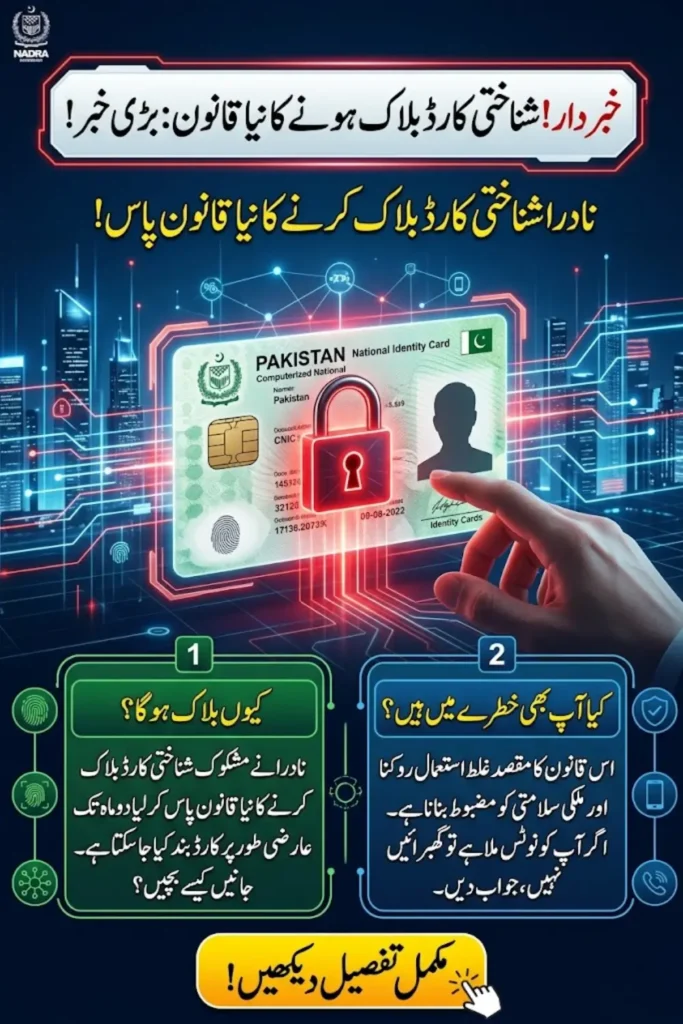
This approval highlights the importance of adapting legal frameworks to match evolving threats. As identity fraud becomes more complex, authorities need updated tools to respond quickly. The amendment ensures that NADRA can act within a clear legal structure while maintaining accountability.
- Approved by Senate Standing Committee on Interior
- Designed to meet modern security needs
- Strengthens NADRA’s legal authority
- Focus on quick and effective action
NADRA CNIC Impoundment Law 2026 and Temporary CNIC Blocking Powers
Under the NADRA CNIC impoundment law 2026, the authority can now provisionally impound CNICs for up to two months. This temporary action is taken while the verification process is ongoing, ensuring that suspicious identities cannot be used during investigations. Previously, legal limitations made it difficult for NADRA to take such steps promptly.
The new powers provide a balanced approach by allowing action without permanently canceling the CNIC. This ensures that genuine users are not unfairly penalized while still enabling authorities to control misuse. The time-bound nature of the law also prevents indefinite restrictions.
- Temporary impoundment for up to two months
- Applies during identity verification process
- Helps address legal gaps in previous system
- Ensures controlled and limited action
You Can Also Read: Xiaomi Redmi Note 15 Pro Price in Pakistan 2026: Full Specs, Features & Honest Review
NADRA CNIC Impoundment Law 2026 to Control Illegal Activities
The NADRA CNIC impoundment law 2026 plays a crucial role in limiting illegal activities carried out using valid identity documents. Suspects and absconders often rely on CNICs to access services such as banking and telecommunications. By restricting their access, authorities can reduce the risk of financial crimes and unauthorized activities.
This approach strengthens coordination between different sectors, including financial institutions and telecom providers. When a CNIC is temporarily impounded, it limits the individual’s ability to operate freely within these systems, supporting law enforcement efforts.
- Prevents suspects from using valid CNICs
- Restricts access to banking services
- Controls use of telecom networks
- Supports law enforcement operations
Due Process Under NADRA CNIC Impoundment Law 2026
The NADRA CNIC impoundment law 2026 includes safeguards to protect citizens from misuse of authority. Officials assured that the process would follow strict legal guidelines, ensuring transparency and fairness. Individuals whose CNICs are impounded will be informed and given an opportunity to respond.
This system ensures that decisions are not made arbitrarily. By including clear timelines and procedures, the law balances security concerns with individual rights. It also builds public trust by maintaining accountability in the verification process.
- Written notice must be provided
- Individuals have the right to respond
- Defined timelines for action
- Ensures fairness and transparency
You Can Also Read: SBP Announces New Facility for Non-Residents: Easy Account Opening & Investment Opportunities in Pakistan
Concerns Related to CNIC Misuse and Identity Issues
During discussions on the NADRA CNIC impoundment law 2026, committee members raised concerns about identity-related issues. Reports suggest that some foreign nationals may possess Pakistani CNICs, while some citizens have faced difficulties due to mistaken identity verification. These challenges highlight the complexity of managing a large identity database.
Authorities have been directed to investigate these issues and resolve them quickly. Ensuring accurate identification is essential for the success of the new law, as errors can affect both national security and public confidence.
- Concerns about foreign nationals holding CNICs
- Cases of citizens wrongly blocked
- Need for improved verification systems
- Directive issued for quick resolution
Role of NACTA in National Security and Counter-Extremism
The National Counter Terrorism Authority provided a briefing alongside discussions on the NADRA CNIC impoundment law 2026. Officials explained that their approach has shifted from passive monitoring to a more proactive, intelligence-based strategy. This change allows them to respond more effectively to emerging threats.
By analyzing extremist content and creating counter-narratives, NACTA aims to reduce the influence of harmful ideologies. Their efforts complement identity verification measures by addressing broader security challenges.
- Intelligence-led counter-extremism strategy
- Analysis of extremist material
- Creation of counter-narrative content
- Active engagement on public platforms
Educational and Social Initiatives by NACTA
As part of its strategy, NACTA has launched educational programs to promote awareness and resilience among young people. These initiatives are being implemented in schools and universities, focusing on constitutional values and responsible citizenship. The goal is to build a stronger, informed society.
Collaboration with civil society organizations has also strengthened these efforts. By involving different stakeholders, NACTA ensures that its message reaches a wider audience and creates long-term impact.
- Programs in schools and universities
- Focus on constitutional values
- Collaboration with civil society
- Awareness campaigns for youth
You Can Also Read: HBL PSL 11 2026 Begins in Lahore: New Teams, Schedule & Major Highlights
Pakistan Penal Code Amendment Bill 2026 Approval
In addition to the NADRA CNIC impoundment law 2026, the committee also approved the Pakistan Penal Code Amendment Bill 2026. This decision reflects a broader effort to update the country’s legal framework and address emerging challenges in law enforcement.
The approval of multiple bills in the same session shows the government’s commitment to strengthening legal systems. These reforms are expected to support national security initiatives and improve overall governance.
- Pakistan Penal Code Amendment Bill approved
- Strengthens legal and enforcement framework
- Supports national security objectives
- Approved unanimously by committee
Key Features of NADRA CNIC Impoundment Law 2026
| Feature | Details |
|---|---|
| Authority | NADRA |
| Action | Temporary CNIC impoundment |
| Duration | Up to 2 months |
| Purpose | Identity verification and security |
| Safeguards | Notice, response, due process |
Impact of NADRA CNIC Impoundment Law 2026
| Area | Impact |
|---|---|
| Security | Reduces identity misuse |
| Banking | Limits access for suspects |
| Telecom | Prevents unauthorized usage |
| Citizens | Improves verification process |
| Government | Strengthens control mechanisms |
Future Implications of NADRA CNIC Impoundment Law 2026
The NADRA CNIC impoundment law 2026 is expected to play a significant role in improving national security and identity management. By allowing temporary action, authorities can respond more quickly to potential threats while maintaining a fair process for individuals. This balance is essential for long-term success.
As implementation begins, continuous monitoring will be required to ensure transparency and effectiveness. Public awareness and proper execution will determine how well the law achieves its objectives without creating unnecessary complications for citizens.
- Better control over identity misuse
- Faster response to security threats
- Need for transparent implementation
- Importance of public awareness
You Can Also Read: PSL 11 Schedule 2026 – Complete Fixtures, Teams, Venues and Match Details
FAQs
What is NADRA CNIC impoundment law 2026?
It is a law that allows NADRA to temporarily block CNICs for up to two months during verification. It helps prevent misuse of identity documents.
Why was this law introduced?
The law was introduced to strengthen national security and stop illegal use of CNICs. It also improves the verification system.
Can NADRA block CNIC without informing the person?
No, NADRA must provide written notice and allow the individual to respond. The process follows legal guidelines.
Who can be affected by this law?
Individuals under verification, suspects, or those involved in illegal activities may be affected. The action is temporary and controlled.
What safeguards are included in the law?
The law includes due process, time limits, and the right to respond. These safeguards ensure fairness and transparency.
You Can Also Read: Pakistan 5G Mobile Phones List 2026: Complete Jazz and Zong Compatible Devices Guide